


Why do mice keep coming back even after you’ve set traps and caught a few? You thought that was the end of it. Then a week later, you spot the droppings again. Same kitchen drawer. Same corner behind the boiler. It can be so frustrating, you think you’re safe and sound then they return!
The traps did not fail you. The problem is just a bit deeper than traps alone can fix.
What kind of mouse are you actually dealing with?
In most homes across inner Glasgow, especially tenement buildings, it is the house mouse. Small, greyish-brown, and very good at keeping itself hidden until numbers have already built up. The house mouse is different from a field mouse in one important way — it does not really leave. Field mice tend to come in during colder months and drift back out when things warm up, which is why some people assume the problem has resolved itself in spring. House mice settle in and stay put.
So if you are seeing them repeatedly across different seasons, that is probably what you are dealing with.
They are following scent trails back in
Mice leave pheromone and urine scent trails as they move around. These are invisible to us but act like a permanent map for other mice. Once a route from outside to a food source inside your home has been marked, it stays marked. Catching the original mouse does not erase the trail, and it does not stop the next one from following the same path in.
This is why recurring mouse problems follow such a predictable pattern — same room, same corner, same entry point. The location itself has become attractive to any mouse in the area.
The entry points are still open
Snap traps, live traps, bait stations — they all deal with mice that are already inside. None of them do anything about how the mice are getting in.
A house mouse can fit through a gap roughly the size of a biro. That is not much. Around pipework, airbricks, the bottom of older doors, where cables come through walls — these are the kinds of spots that rarely get a second look. Skirting boards that do not sit flush, vent openings that have lost their covers, utility chases that were never properly sealed. In older properties you tend to find several of these at once, and mice will find every single one of them.
Until those entry points are properly sealed, you are dealing with a revolving door. Traps will keep catching mice without ever reducing the underlying pressure.
There is still something worth coming back for
Mice want food, warmth and somewhere quiet to nest. If your home offers any of those things, they will keep trying.
Pet food is probably the most common thing we see. Left in a bowl overnight, it is basically an open invitation. Beyond that, it is often the less obvious stuff — crumbs that have worked their way under the cooker, a compost bin with a loose lid, food kept in cardboard boxes in a cupboard. Mice can smell food from a long way off, and once they know it is there, they are not easily put off.
Nesting sites are equally important. Mouse nests are typically built in quiet, undisturbed spots — inside wall cavities, under floorboards, in loft insulation, or behind large appliances. Cluttered storage areas, particularly those with cardboard boxes or fabric, are ideal nesting areas. If the conditions inside your home are comfortable, mice will not leave voluntarily.
Incomplete proofing leaves the door open
A common mistake with DIY pest control is sealing one obvious entry point while missing several others nearby. Proofing and prevention requires a whole-building approach — looking at the roofline, subfloor, pipe runs, vent openings and structural joints together rather than patching individual gaps as they become obvious.
Materials matter just as much as coverage. Expandable foam alone is not sufficient — mice gnaw through it with minimal effort. Effective sealing uses steel mesh or wire wool packed into gaps before any filler is applied over the top. DIY barriers that skip this step tend to fail within weeks. Rodent-resistant barriers are a different proposition entirely, and getting this right is usually where professional pest control earns its value.
Signs the problem is bigger than a couple of mice
If you are still getting activity after trapping, the infestation is probably more established than it looks. Fresh droppings are the obvious sign, but gnaw marks on skirting boards or cables, hearing movement in walls or ceilings at night, or finding shredded material tucked into a corner somewhere — these suggest mice have been settled in for a while. It matters because mice reproduce fast. A small number becomes a much bigger number quickly, and the longer it goes on the harder it is to deal with. The British Pest Control Association guidance on mice provide even more information.
The garden matters more than people think
Most of the focus tends to go on what is happening inside, but what is going on outside the building makes a difference too. Long grass or overgrown shrubs close to the walls give mice somewhere to shelter right next to your home. An accessible compost heap or a bin that does not close properly is a food source that brings them to your door before they ever try to get in. Tidying up the immediate area around the building is one of the simpler things you can do, and it does reduce the pressure.
What actually stops mice from coming back for good
Long-term mouse control requires two things working together: removing what is attracting them, and blocking the ways they can get in.
That means improving food storage properly and maintaining it as a habit — not just for a week after spotting a mouse. It means proper sealing of entry points with the right materials. It means being consistent about pet food, bin lids, and garden hygiene. And it means monitoring for signs of activity so problems are caught early rather than allowed to develop.
If mice keep returning despite your efforts, a professional inspection is the logical next step. Mouse control treatments applied without a proper survey of entry points and attractants rarely hold long term.
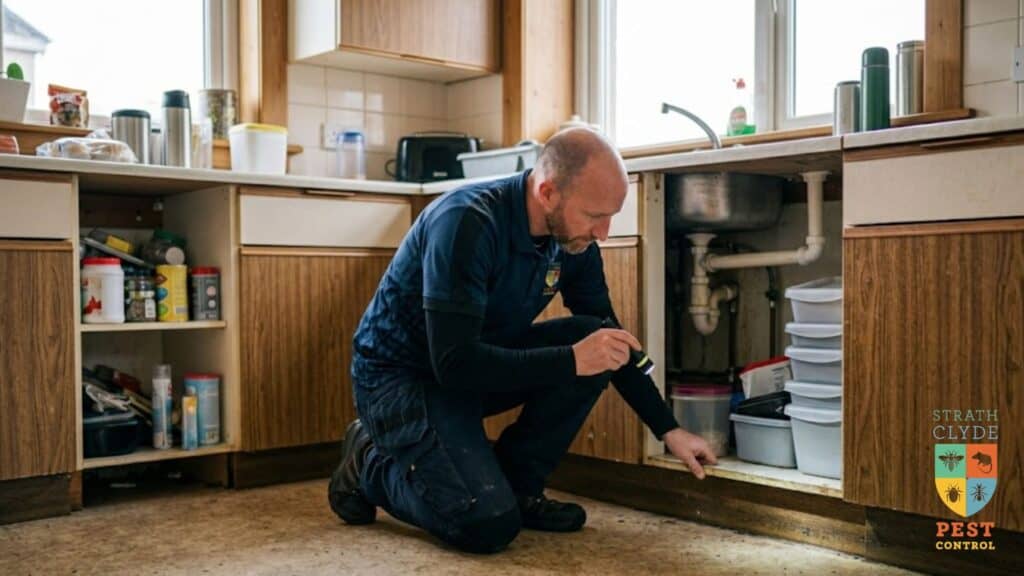
Still seeing mice? We can help.
If mice keep coming back, there is usually a reason — and it is normally something that traps alone cannot fix. At Strathclyde Pest Control we work across Glasgow, East Kilbride and Lanarkshire, and this kind of recurring mice problem is something we deal with regularly. We will inspect the property properly, find where they are getting in, and sort the proofing with materials that actually hold. Get in touch and we will take a look.

