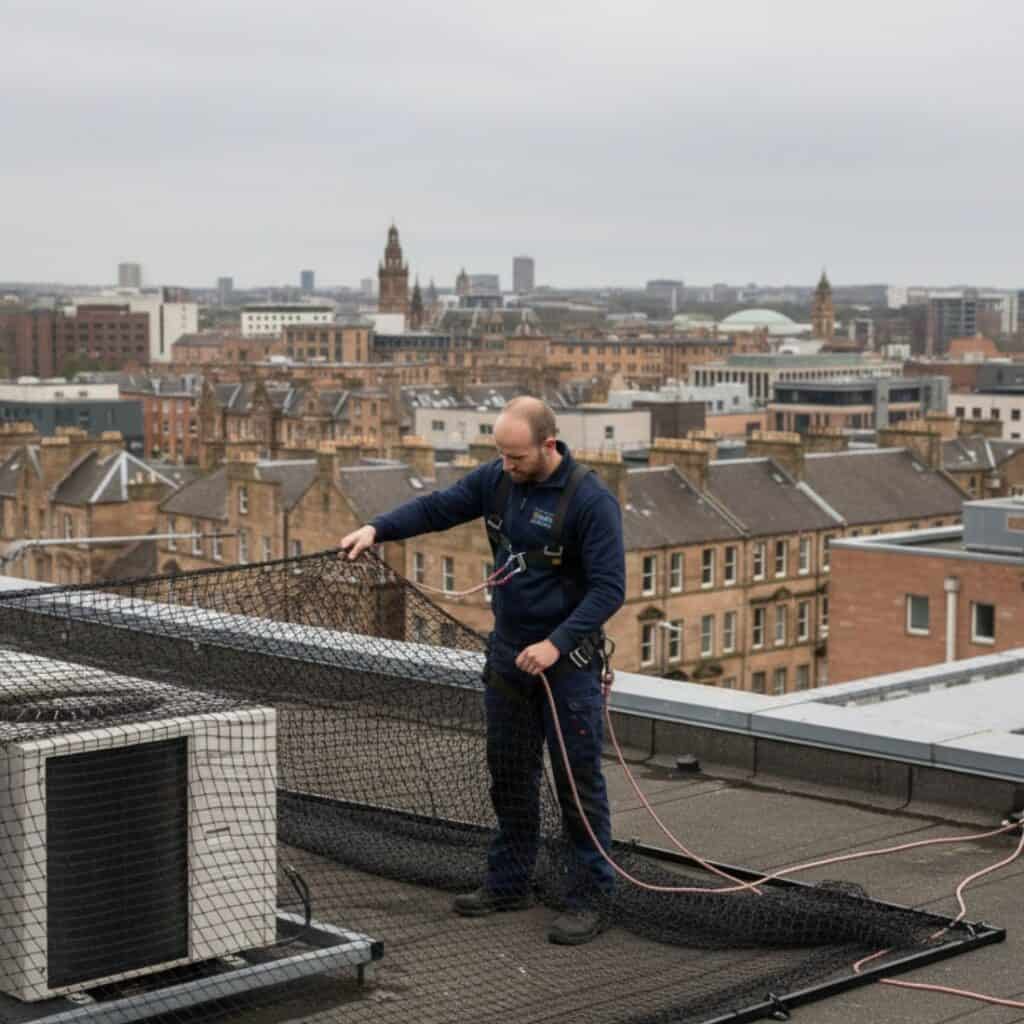

Seagull Control in Glasgow & East Kilbride
Seagulls can quickly become more than just a noisy nuisance. If they are nesting on your roof or gathering around your building, the problem tends to grow fast. At Strathclyde Pest Control, we provide practical, lawful seagull control in Glasgow and East Kilbride to help protect homes and businesses from damage, mess and disruption.
We are a local family-run business, and we deal with this issue regularly across the area. Whether it is a tenement roof in Glasgow or a retail unit in East Kilbride, we know how to handle it properly.

Why You Need Professional Seagull Control in Glasgow
Seagulls are protected under UK wildlife law. That means you cannot simply remove nests or disturb them without the proper permissions and approach. This is where many DIY attempts go wrong.
Aside from the legal side, seagulls create very real problems. Their droppings are acidic and can damage roofing materials, solar panels, guttering and paintwork. We regularly see blocked gutters and stained brickwork caused by long-term nesting. On commercial properties, the mess around entrances can affect how your business looks to customers.
There is also the noise. During nesting season, seagulls become territorial and aggressive. Dive-bombing is not uncommon, particularly if there are chicks on the roof. For families with young children or for staff entering and leaving a building, this can be stressful.
Health risks are another factor. Seagull droppings can carry bacteria, and where birds are roosting in numbers, there is often a build-up of parasites and mites. In Glasgow and East Kilbride, we see this especially on flat roofs and larger commercial units.
- Loud, regular calling early in the morning
- Birds repeatedly landing on the same section of your roof
- Nesting material near chimney stacks, flat roof edges or behind parapet walls
- A build-up of droppings on paths, cars or window ledges
- Birds swooping or acting aggressively when you walk past
- Young birds visible on the roof during late spring or summer
If you are seeing more than one of these signs, the chances are you have an active nesting site and it is unlikely to sort itself out without proper seagull control in Glasgow.

Seagull problems follow a fairly predictable yearly pattern. Here is what we typically see across Glasgow and East Kilbride:
January to February
Quieter period. Gulls may roost on rooftops but nesting has not usually started. Good time to plan preventative proofing.
March to April
Nest building begins. Birds become more territorial around chosen roof areas.
May to June
Eggs hatch. Adult gulls are highly protective and more likely to swoop or act aggressively.
July to August
Chicks grow and start moving around rooftops. Noise levels often peak during this stage.
September to October
Nesting activity winds down. Birds may still roost but aggression reduces.
November to December
Mainly roosting behaviour. Ideal window for installing proofing before the next nesting season starts.
Acting before spring makes seagull control in Glasgow far more straightforward, as legal restrictions apply once eggs or chicks are present.
We are based locally and know the types of properties across Glasgow and East Kilbride. From older tenements to modern retail parks, the approach needs to suit the building.
We carry out proper assessments rather than rushing into a one-size-fits-all solution. In many cases, the issue is repeat nesting. Without proper proofing, it simply returns the following year.
All work is carried out in line with current wildlife legislation. If licences are required, we advise you properly. We also provide straightforward guidance on keeping bins secure and reducing food sources around the property.