

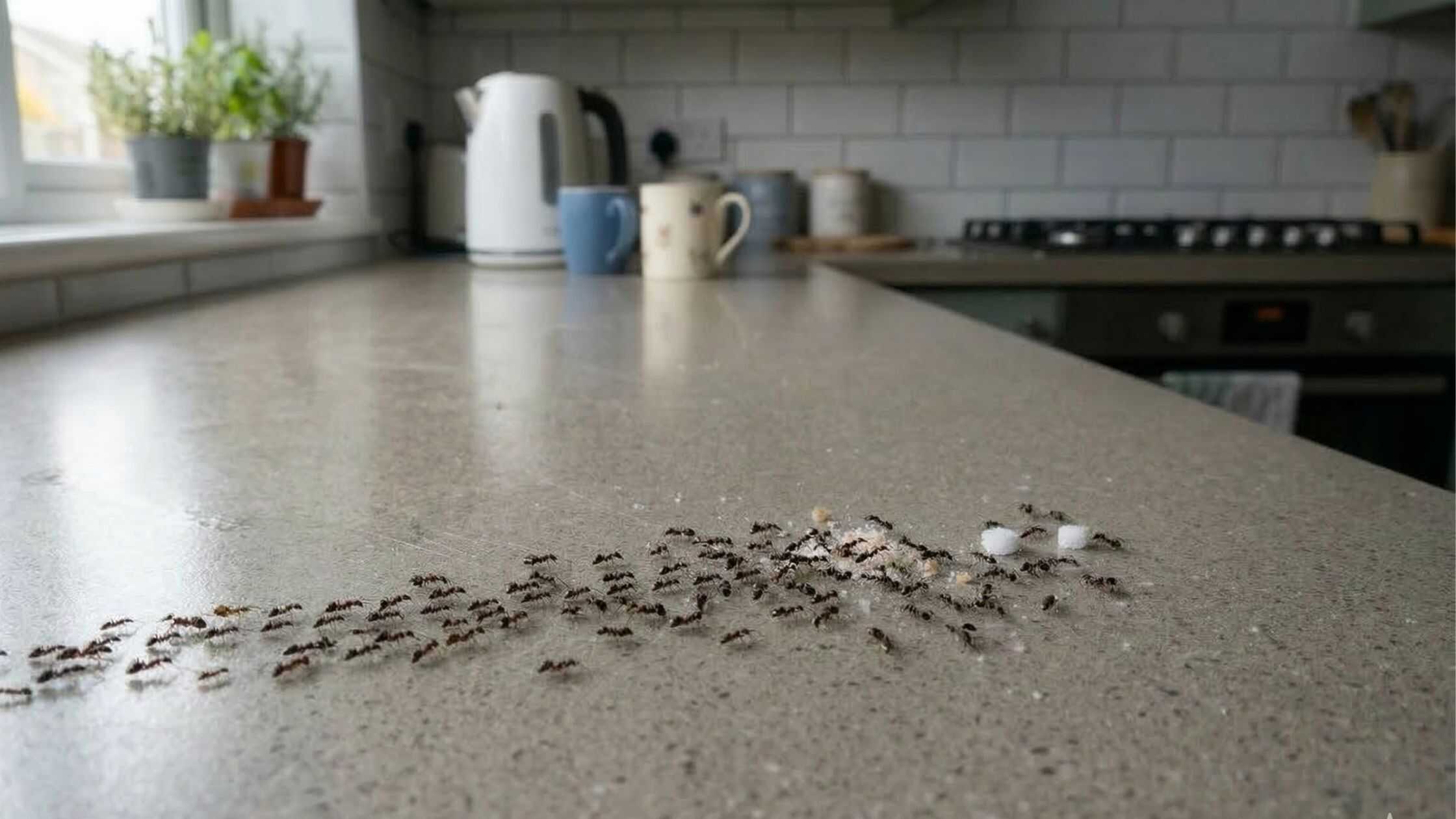
Noticing ants in your kitchen recently? You come down to make your first coffee of the day and notice a straight line across the worktop, what is it? A steady stream of ants has appeared in your kitchen!
Like many of our Strathclyde Pest Control customers you have probably noticed them near the same places. Around the kettle. Along the edge of the worktop. Sometimes beside the sink or near a cupboard where food is stored. You wipe them away, clean the surface and think that’s the end of it. I have beaten the ants!
Then a day later they appear again. This time there are more of them, often following the same small path along the floor or the skirting board. If you keep seeing ants appearing in kitchens and other places around your home during spring, fear not, it is a very common problem in homes across East Kilbride and the wider Glasgow area. Once the weather begins to warm up (if it ever does…), ant colonies become active again and the worker ants start on their main mission, searching for food. Your beautiful kitchens provide exactly what they are looking for: a room full of easily accessible tasty treats to get them ready for a new year of activity.
In many cases the ants you are seeing are only the beginning of a trail connected to a much larger ant colony somewhere nearby.
Why ants start appearing in kitchens during spring
The ants most people see indoors in Scotland are Black Garden Ants. They are extremely common and are found across gardens, paths and housing estates throughout East Kilbride and Glasgow.
In the colder months these ant colonies will stay fairly inactive underground and out of sight. However, when spring finally comes (and we have been promised it will), the ant colony comes to life and will start expanding again. The busy worker ants then leave the nest to search for food sources.
If one ant finds something useful and delicious to them such as sugar, crumbs or other food residue, it hot foots back to the nest all the while leaving a scent trail behind it. Other ants from the colony can then easily follow that same route and find the precious food.
This is why many people (including our customers) suddenly notice what looks like an organised trail of ants moving across a kitchen floor or along the edge of a worktop. What many homeowners do not realise is that the nest itself is very often outside the house.
Why homes in East Kilbride often experience ant problems
Interestingly, most ant nests we find locally are not inside the building. Rather, they are usually somewhere in the garden or around the structure of the property.
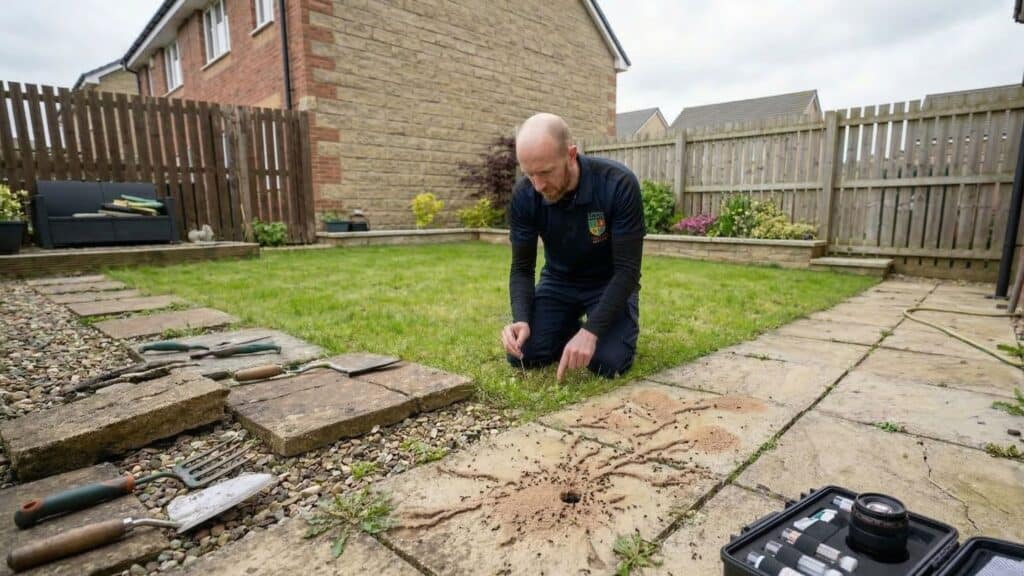
Ants tend to favour nesting locations such as the space under paving slabs and garden paths, areas beneath decking, soil near house foundations or the sandy areas under patio stones. The many housing estates we have in and around East Kilbride provide plenty of these kinds of ant friendly spaces where they can nest without being disturbed. The Royal Horticultural Society explains that garden ants commonly build nests under paving and soil close to buildings, which is why they frequently enter homes during warmer months.
When the ants are in, settled and have made their nest, if it’s close to a property it is then surprisingly easy for ants to find their way indoors. They only need the smallest gap! Those tiny cracks around older window frames, the spaces beneath doors and floors, pipe entry points or small gaps in brickwork can all act as entry routes. Remember they are small little creatures and very clever, their ability to get into areas never ceases to amaze us.
Unfortunately for you, kitchens are a favourite location that attracts ants once they get inside. No matter how good we are at cleaning we can sometimes leave food crumbs, small spills, pet food bowls and sugar residue from that lemon drizzle cake you just made. All these things left out on worktops are enough to keep them returning to the same area.
Many of our regular customers say that they often noticed ants first appeared near their sugar jar or around the kettle area where delicious sugar is added into a good hot cup of tea!
All these ants! Is it something for me to worry about?
Unlike many other pests that sadly get into our homes, ants in the kitchen are more of a nuisance than a serious health concern. The species that we most commonly seen in homes and even businesses around East Kilbride do not damage buildings and are thankfully not considered a major disease risk. This should help to keep us from worrying too much if we see them at home.
Having said that, they are still not something you want around food preparation areas. Ants travel across outdoor surfaces, soil and drains before entering a property, so they can easily contaminate kitchen areas if left untreated. You wouldn’t drag your food across these areas and then cook or eat it, so to be on the safe side it’s good to act quickly to clear up any ant infestations.
Where the real concern should be is the main issue – the size of the main ant colony. Don’t forget that the ants you see indoors are worker ants sent out to collect food. So, if the queen and the nest remain active and untouched, the colony will keep on sending more worker ants along the same route. This is why wiping away the ants you see rarely solves the problem completely. So what can you do?
Practical steps to get rid of ants in your kitchen
There are a few simple steps homeowners in East Kilbride or Glasgow can try before calling pest control.
Remove food sources that attract ants. Wipe down kitchen worktops thoroughly, clean areas where crumbs collect and keep food sealed properly in cupboards. Even small amounts of sugar that missed the teacup or cooking leftovers from your last stir fry can attract ants repeatedly.
Check entry points. Small gaps around pipes, window frames or door thresholds can sometimes be sealed with silicone sealant to block the route the ants are using. This is especially important in older homes where, as the years pass, older seals might fail or become damaged.
Try natural deterrents. White vinegar or lemon juice wiped along an ant trail can sometimes disrupt the scent trail temporarily. Peppermint oil is another method people sometimes use. Please remember though these methods may slow the activity for a short time, but they rarely eliminate the cause of the problem, the main nest itself.
Why do DIY ant treatments often fail?
When the ants appear we often instinctively wipe them all away thinking if we cut their trail they will be scared and not come back. Sadly this is not the case. Whether it’s a quick clean, a natural remedy such as those mentioned above or shop bought products, ants often return. This is because most DIY treatments treat only the symptoms not the main cause. This mistake of focusing only on the ants they can see in the kitchen is often why DIY treatments fail.
Nests are hard to find and treat, and, sometimes require a trained eye and some skill. That’s because the nest itself is often hidden somewhere outside the property or beneath the ground. So as long as it stays hidden and untreated the ants will likely keep coming back. This is why professional treatment is needed.
Professional ant treatments often rely on bait systems that worker ants carry back to the colony. This allows the treatment to spread through the nest and eventually reach the queen. This will help to destroy the nest and prevent further ant infestations in your home.
The British Pest Control Association explains that successful ant control usually depends on identifying the nest location or using targeted bait treatments rather than simply killing visible ants.
When to contact professional pest control
If ants keep returning to the same areas of your kitchen despite cleaning and sealing entry points, it usually means the colony is well established nearby. At this point professional pest control is often the quickest and most reliable solution. At Strathclyde Pest Control we can inspect the property, identify where the ants are entering and locate the likely nesting areas around the building.
Once the nest is identified we can provide the correct treatment to the source of the colony. Once this is done, the activity indoors usually stops quite quickly.
If you are dealing with persistent ants indoors, you can learn more about our local ant treatment service here and request a visit to help you get rid of your ants as soon as possible.
To summarise…
Ants appearing in kitchens during spring are a very common problem so don’t worry too much. Remember that as the weather warms up the ant colonies become active again and worker ants begin searching for food sources. This often means your kitchen!
Cleaning surfaces and sealing small entry points can sometimes reduce the problem early on.
However, if the ants continue returning, there is usually a nest nearby that needs to be treated properly. Once the colony itself is dealt with, the trails inside the house normally disappear and the kitchen returns to normal.

