

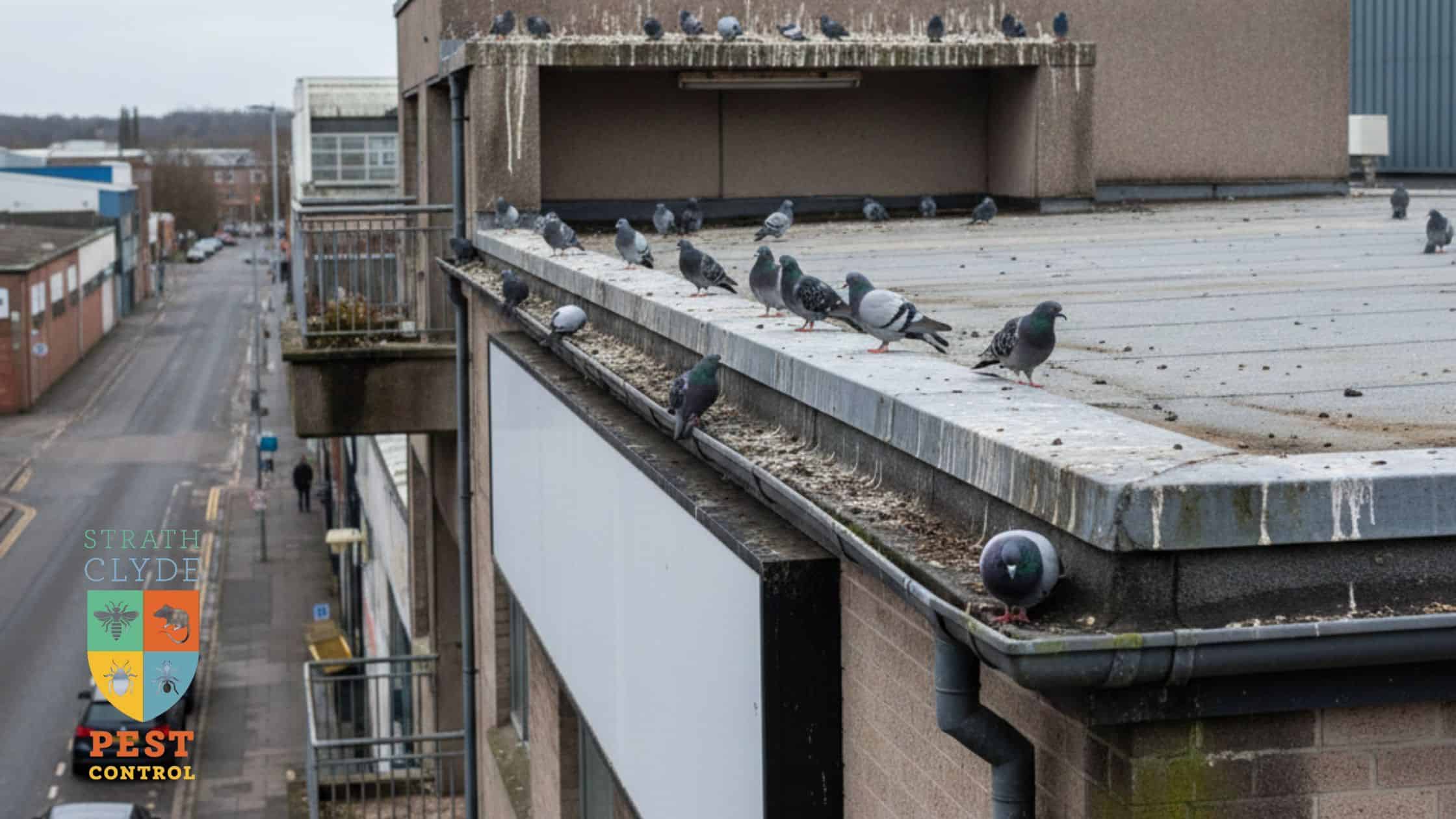
If you run a business premises in or around Glasgow and East Kilbride, you’ve probably seen it at some point: pigeons perched along a roof edge, sitting under solar panels, or pacing about on a flat roof like they own the place. It’s easy to shrug off at first. They’re just birds, right? And they are everywhere! The trouble is, feral pigeons are not “just a nuisance” once they start roosting regularly on a building. Over time they can cause real mess, real cost, and real headaches for staff, customers, and landlords.
At Strathclyde Pest Control, we get plenty of calls from businesses that only realised the scale of it once the signs were impossible to ignore. The outside seating got constantly fouled. The shopfront started to look grubby no matter how often it was cleaned. Gutters overflowed. A warehouse entrance became a daily clean-up job. By that point, you’re already paying for the problem in time, cleaning, call-outs, and reputation.
This article explains what pigeons can do to a building, the signs to watch for, what you should not do, and what a sensible, legal plan looks like for prevention and control.
The quick answer: Can pigeons cause damage to a house or commercial building?
Yes, they can. The biggest issues we see are:
- Heavy fouling that stains and corrodes building materials over time
- Blocked gutters and drainage from nesting and debris
- Slips and hygiene issues around entrances, fire exits, loading bays, yards, and bin areas
- Damage to rooflines, ledges, and protected empty spaces where birds repeatedly roost
- Knock-on costs: increased cleaning, repairs, complaints, and sometimes pest secondary issues (mites, flies, and other insects associated with nesting material)
For businesses, the damage is not only physical. It’s also “how the place looks and feels”. Customers notice it. Staff get fed up. And it becomes one more thing you’re dealing with when you’ve already got a hundred jobs on.
Why feral pigeons become a problem on business premises
Feral pigeons thrive in towns and cities because buildings give them what cliffs would give them in nature: ledges, shelter, and height. Add warm service areas, food availability from litter and bins, and quieter roof spaces, and you’ve got a perfect setup for roosting.
On commercial sites, the common hot spots are:
- Shopfront signage and canopy areas
- Flat roofs and roof edges
- Loading bays and sheltered entrance recesses
- Bin stores and waste areas
- Under solar panels and behind rooftop plant equipment
- Warehouses with high beams, open doors, and sheltered yard areas
Once pigeons choose a regular roost, they tend to return repeatedly. That’s when the issue shifts from “we’ve seen a few birds” to “we can’t keep on top of the mess”.
What is the problem with feral pigeons, specifically?
There are three main problems: fouling, nesting debris, and persistence.
1) Fouling builds up faster than you think
Pigeon droppings are not like a bit of mud that rinses away. They can be acidic and they stain porous materials. Over time, repeated fouling can discolour stone, brick, render, signage, and metal surfaces. That’s before you factor in the cost of repeated cleaning, especially if the mess is high up or in awkward access areas.
2) Nesting material blocks gutters and creates water issues
When pigeons nest in roof spaces, gutters, or sheltered corners, they drag in twigs, leaves, and debris. That can block drainage and cause overflowing gutters. In winter, that “small blockage” becomes a bigger issue when rain and wind pick up. Overflowing water and damp patches can then lead to secondary problems like mould, damaged paintwork, and avoidable repair work.
3) They keep coming back if nothing changes
This is the part many businesses underestimate. If the building has easy roosting points and the birds have learned it’s safe, they’ll keep using it. A one-off clean helps for a week. Sometimes for a day. If you don’t tackle access points and roosting surfaces, the pigeons have no reason to stop.
Signs pigeons are already causing damage (even if you do not see them every day)
Sometimes the birds disappear during parts of the day, especially if it’s busy or noisy at ground level. You can still spot the damage early if you know what to look for:
- White streaking on walls, downpipes, signage, window ledges, and cladding
- Feathers and nesting debris collecting in the same spots
- Blocked gutters, overflowing downpipes, damp patches after rain
- Repeated droppings near entrances, fire exits, loading bays, and outdoor seating
- Staff regularly cleaning the same area with no lasting improvement
- Customers commenting on mess or smell around the entrance
If you’re a facilities manager, landlord, or business owner, it’s worth doing a quick walk-round after heavy rain. Water patterns often reveal where gutters are blocked or where drainage is failing.
Are pigeons classed as pests in the UK?
In practical terms, yes, feral pigeons are widely treated as pest birds when they create a hygiene risk, nuisance, or damage to property. That said, bird control must still be approached properly and legally. This is where many people get caught out.
Are feral pigeons protected? What is the law on getting rid of pigeons?
This is the bit that needs care. In the UK, wild birds are protected by law, and you cannot just do “anything you like” because a bird is annoying you. There are lawful routes to managing pest birds, but they need to be done in line with the rules and best practice.
In Scotland, general licences are one of the frameworks that can apply to certain situations, but they come with conditions and responsibilities. If you want to read the official guidance, NatureScot publish Scotland’s general licences and updates here. nature.scot
The short version for businesses is: do not improvise. Do not rely on “someone said it’s fine”. If you need bird control, do it properly, with the right method for the site and the right compliance approach.
Are pigeons a statutory nuisance?
They can be, depending on the situation. Statutory nuisance is usually about the impact (for example, persistent fouling, smell, and the effect on health or enjoyment of a property), not just “there are pigeons nearby”. If you’re dealing with repeated fouling or significant build-up that’s affecting neighbouring premises, it’s sensible to treat it as more than a minor annoyance and get it assessed.
For businesses, the practical takeaway is simple: if it’s affecting operations, staff, customers, or the condition of the building, you’re already past the point of “leave it and see”.
Health risks: what feral pigeons can mean for staff and customers
Most business owners ask us two questions: “Is it dangerous?” and “Is it going to get us in trouble?”
Pigeons create hygiene issues because droppings and nesting debris are not something you want around food areas, customer entrances, or indoor spaces. Dried droppings can also become airborne as dust when disturbed during cleaning. You also sometimes see secondary pest issues around nesting sites, like bird mites or flies linked to debris and waste build-up.
This is exactly why prevention matters. It keeps the outside areas cleaner, reduces the need for harsh cleaning routines, and lowers the chance of secondary problems showing up later.
What not to do (because it usually makes it worse)
There are a few “quick fixes” we see all the time that either fail or cause new problems:
Do not feed them “to keep them away from the door”
It does the opposite. Feeding anchors birds to the site and increases the number returning.
Do not pressure wash droppings without thinking
If you blast old droppings everywhere, you can spread contamination across walls, yards, and surrounding surfaces. Cleaning needs to be planned properly, especially in customer-facing areas.
Do not put up random deterrents and hope
Cheap plastic owls and a bit of shiny tape sometimes move birds for a day or two, then the pigeons learn it’s harmless. If the building has strong roosting points, the birds come back.
Do not block access holes without checking what’s behind them
If birds are already nesting in a void, blocking entrances can trap birds in, create welfare issues, and leave you with a worse clean-up afterwards.
The most effective methods to prevent pigeon-related damage
The best solution depends on the building and how pigeons are using it. There isn’t one magic product that fits every site. In Glasgow and East Kilbride, we most often recommend a mix of:
Proofing and exclusion
This is about removing access to the places pigeons want to roost and nest. Typical examples include netting in suitable areas, mesh or proofing around certain voids, and closing off repeated entry points that are allowing nesting and debris build-up.
Anti-roost measures on ledges and signage
On some buildings, ledges and parapets are the main issue. The goal is to make those surfaces unattractive or impossible to perch on properly, without creating hazards for the public.
Site housekeeping that removes the “welcome mat”
This matters more than people think. If bins are overflowing, food waste is exposed, or staff areas have regular litter, you increase the chance pigeons anchor to the site. The building itself is one part of the story. The routine around it is the other.
How Strathclyde Pest Control approaches feral pigeon problems
On business sites, we always start with a proper look at how the birds are using the building. Not just “there are pigeons”. We look for:
- Where they land and roost most often
- Where fouling is building up and where it’s travelling in rain
- Nesting points (especially under panels, in sheltered corners, or in roofline voids)
- The reason they picked the site (food source, shelter, access, quiet roof space)
From there, we recommend a plan that suits the building. For some businesses, it’s targeted proofing in one or two areas. For others, it’s a more joined-up approach because the building layout gives pigeons too many easy options. If you want to talk it through or book a site visit, you can contact us here: Contact Strathclyde Pest Control
Keeping it under control long-term (especially for repeat problem buildings)
Some sites get hit year after year. Often it’s because the building has strong roost points and nearby food availability. If that’s you, a one-off response every time the mess returns is the expensive way to handle it.
A better approach for many businesses is to 1) Identify the repeat roost points 2) Proof those areas properly 3) Put a simple maintenance routine in place so small build-ups do not become big ones and 4) Re-check after winter storms or building works (scaffolding and roof jobs often change bird behaviour)
If your building is managed, rented, or shared, it’s also worth making sure responsibility is clear. Pigeon issues often sit in the grey area between tenant and landlord until the damage becomes obvious.
A quick note for homeowners
We’re focusing on businesses here, but the same story applies to houses too. If pigeons are roosting on your roofline, in a solar panel gap, or on a chimney ledge, the droppings and blocked gutter risk still applies. It’s just usually smaller scale. The sooner it’s addressed, the easier it is to prevent long-term staining, damp patches, and constant cleaning.
Frequently asked questions
Are pigeons classed as pests in the UK?
Feral pigeons are commonly treated as pest birds when they cause hygiene issues, nuisance, or property damage. Control still needs to be lawful and properly carried out.
Are feral pigeons protected?
Wild birds are protected in the UK, and you cannot take random action without considering the legal side. In Scotland, NatureScot publish guidance and general licences that may apply in certain situations, with conditions. nature.scot
What is the law on getting rid of pigeons?
The lawful route depends on what’s happening on the site, what methods are being used, and whether there are nesting/welfare concerns. The safest approach is to get professional advice and use compliant prevention and control methods rather than improvising. nature.scot
Are pigeons a statutory nuisance?
They can be, depending on the severity and impact (persistent fouling, hygiene impact, effect on neighbours or premises). If it’s affecting business operations or the condition of the building, treat it as a real issue and get it assessed early.
Can pigeons cause structural damage to commercial buildings in Glasgow and East Kilbride?
They can contribute to building deterioration over time through repeated fouling, blocked drainage, and damp-related knock-on issues. The bigger “damage” cost for many businesses is ongoing cleaning, repairs, and the impact on how the premises looks to customers.
What are the most effective methods for businesses to prevent pigeon-related damage?
Usually a combination of proofing/exclusion, anti-roost measures on key ledges, and reducing attractants around waste and food areas. The right option depends on the building layout and how pigeons are using it.
Next step: get it checked before it becomes a constant issue
If pigeons are fouling your entrance, roosting on signage, or nesting around rooflines, it’s worth sorting early. It’s cheaper, it’s cleaner, and it avoids the point where staff are battling the same mess every morning.
To book a visit or ask for advice, contact Strathclyde Pest Control HERE

